-
Shop
- Adidas
- Advanced Technologies
- AI Skills
- AI Skills Mastery 2026 Collection
- Arts, Crafts & Hobbies
- Car Accessories
- Confidence
- Dating & Social Confidence
- Dating & Social Skills
- Digital Resources
- Education & Learning
- Family & Parenting
- Fashion
- Gadgets
- Health & Beauty
- Health & Wellness
- Home & Garden
- Kids & Babies
- Kitchen
- Lighting
- Luxury Brands Collection
- Patio, Lawn & Garden
- Personal Growth
- Pet Care
- Pet Supplies
- Pets
- Smart Home Living Guides
- Sport & Outdoors
- Travel
- Travel & Adventure
- Wealth
- Wealth Building
- Budgeting & Saving
- Cryptocurrency Investing
- Debt Management
- Entrepreneurship & Business Growth
- Family Finance & Budgeting
- Financial Independence
- Financial Mindset & Psychology
- Financial Planning
- Frugal Living & Expense Hacks
- Goal Setting
- High-Income Skills
- Investing Basics
- Leadership
- Motivation
- Networking & Mentorship
- Passive Income Strategies
- Real Estate Investing
- Side Hustles
- Stock Market Investing
- Popular
- Best deals


Product Description
Unlock the Secrets Behind Every Iconic Dior Piece
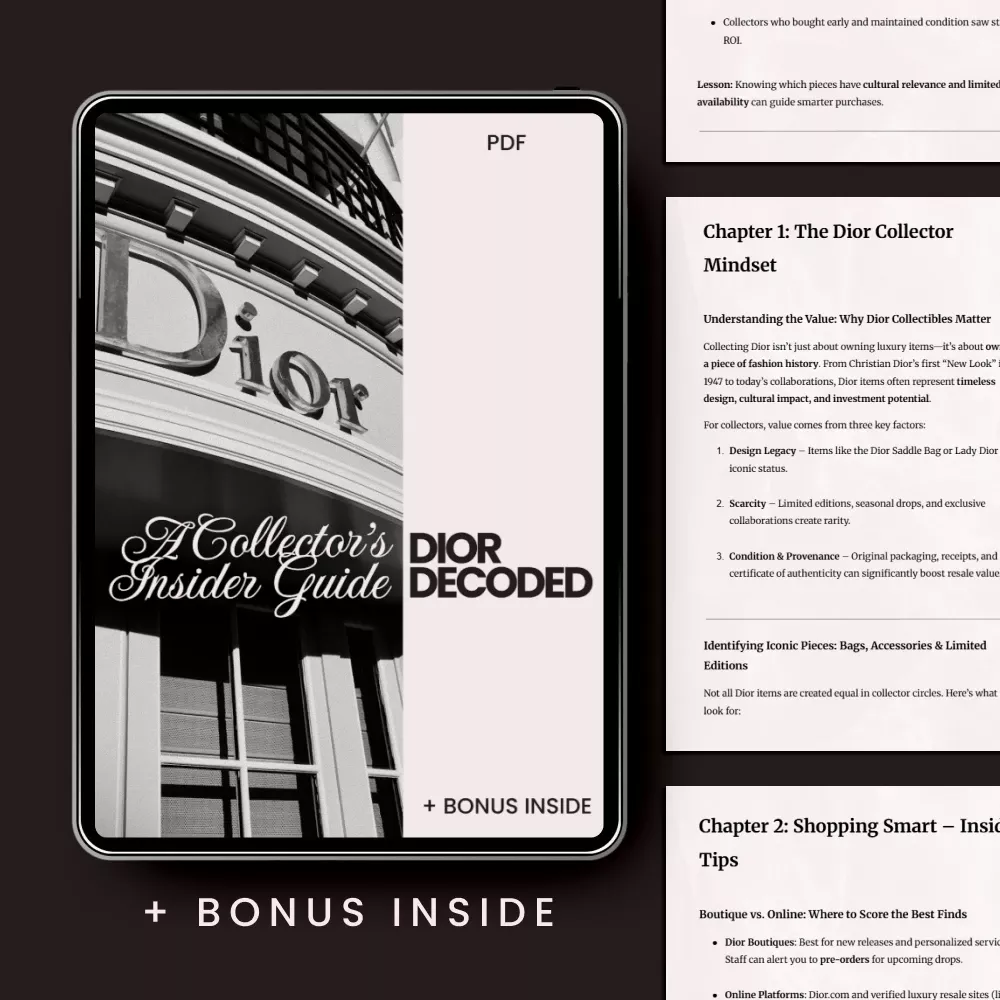
If you’ve ever wondered how seasoned collectors always seem to score the most coveted Dior pieces before they skyrocket in value, Dior Decoded: A Collector’s Insider Guide is your behind-the-scenes pass into the world of strategic luxury collecting. This comprehensive digital guide is designed for fashion lovers, serious collectors, and savvy investors who want more than just beautiful pieces—they want smart acquisitions. Packed with expert-level dior shopping tips for collectors, this guide walks you through exactly how to build, protect, and grow a Dior collection with confidence.
What’s Inside This Guide
- Chapter 1: The Dior Collector Mindset – Learn why Dior collectibles hold value, how to identify iconic bags and accessories, and explore a real-life case study on the resale rise of the Dior Book Tote.
- Chapter 2: Shopping Smart – Insider Tips – Discover boutique vs. online strategies, the power of timing and limited drops, common collector mistakes, and how AI tools can support trend prediction and resale analysis.
- Chapter 3: Authenticity & Preservation – Master the red flags of counterfeits, proper storage and maintenance techniques, plus a case study on restoring a vintage Dior Saddle Bag.
- Chapter 4: Growing Your Dior Collection – Learn how to network within the collector community, navigate resale and auction strategies, and create your personalized Dior collection roadmap.
Why You’ll Love It
- Clear, actionable dior shopping tips for collectors you can use immediately
- Real-world case studies that show how value grows over time
- Beginner-friendly explanations with advanced-level insights
- Investment-focused strategies rarely shared publicly
- Instant digital download—no waiting, start today
Who This Is For
This guide is perfect for aspiring Dior collectors, seasoned luxury resellers, fashion investors, and anyone who wants to shop smarter and avoid costly mistakes. Whether you’re buying your first Dior bag or expanding a curated archive of limited editions, this resource gives you a structured, strategic advantage.
What Makes It Different
Unlike generic fashion guides, Dior Decoded: A Collector’s Insider Guide blends collector psychology, data-driven tools, authenticity education, and long-term investment planning into one cohesive roadmap. It doesn’t just tell you what to buy—it teaches you how to think like a true Dior collector.
Start Building Your Dream Collection Today
Luxury is more than a purchase—it’s a strategy. Download Dior Decoded: A Collector’s Insider Guide now and gain the clarity, confidence, and insider knowledge you need to shop smarter, protect your investments, and grow a Dior collection you’ll be proud of for years to come.
Shipping & Delivery
SHIPPING
We are proud to offer international shipping services that currently operate in over 200 countries and islands world wide. Nothing means more to us than bringing our customers great value and service. We will continue to grow to meet the needs of all our customers, delivering a service beyond all expectation anywhere in the world.
Do you ship worldwide?
Yes. We provide free shipping to over 200 countries around the world. However, there are some locations we are unable to ship to. If you happen to be located in one of those countries we will contact you.
What about customs?
We are not responsible for any custom fees once the items have been shipped. By purchasing our products, you consent that one or more packages may be shipped to you and may get custom fees when they arrive to your country.
How long does shipping take?
Shipping time varies by location. These are our estimates:| Location | *Estimated Shipping Time |
|---|---|
| United States | 5-20 Business days |
| Canada, Europe | 5-20 Business days |
| Australia, New Zealand | 5-20 Business days |
| Central & South America | 5-25 Business days |
| Asia | 5-20 Business days |
| Africa | 5-25 Business days |
Do you provide tracking information?
Yes, you will receive an email once your order ships that contains your tracking information. If you haven’t received tracking info within 5 days, please contact us.
My tracking says “no information available at the moment”.
For some shipping companies, it takes 2-5 business days for the tracking information to update on the system. If your order was placed more than 5 business days ago and there is still no information on your tracking number, please contact us.
Will my items be sent in one package?
For logistical reasons, items in the same purchase will sometimes be sent in separate packages, even if you've specified combined shipping.
If you have any other questions, please contact us and we will do our best to help you out.
RETURNS
Order cancellation
All orders can be cancelled until they are shipped. If your order has been paid and you need to make a change or cancel an order, you must contact us within 12 hours. Once the packaging and shipping process has started, it can no longer be cancelled.
Refunds
Your satisfaction is our #1 priority. Therefore, you can request a refund or reshipment for ordered products if:
- If you did not receive the product within the guaranteed time (45 days not including 1-3 day processing) you can request a refund or a reshipment.
- If you received the wrong item you can request a refund or a reshipment.
- If you do not want the product you’ve received you may request a refund but you must return the item at your expense and the item must be unused.
We do not issue the refund if:
- Your order did not arrive due to factors within your control (i.e. providing the wrong shipping address)
- Your order did not arrive due to exceptional circumstances outside the control of estalen.com (i.e. not cleared by customs, delayed by a natural disaster).
- Other exceptional circumstances outside the control of estalen.com.
*You can submit refund requests within 15 days after the guaranteed period for delivery (45 days) has expired. You can do it by sending a message on Contact Us page
If you are approved for a refund, then your refund will be processed, and a credit will automatically be applied to your credit card or original method of payment, within 14 days.
Exchanges
If for any reason you would like to exchange your product, perhaps for a different size in clothing, you must contact us first and we will guide you through the steps.
Please do not send your purchase back to us unless we authorise you to do so.
Refunds & Returns
Order cancellation
All orders can be cancelled until they are shipped. If your order has been paid and you need to make a change or cancel an order, you must contact us within 12 hours. Once the packaging and shipping process has started, it can no longer be cancelled.
Refunds
Your satisfaction is our #1 priority. Therefore, you can request a refund or reshipment for ordered products if:
- If you did not receive the product within the guaranteed time( 45 days not including 2-5 day processing) you can request a refund or a reshipment.
- If you received the wrong item you can request a refund or a reshipment.
- If you do not want the product you’ve received you may request a refund but you must return the item at your expense and the item must be unused.
We do not issue the refund if:
- Your order did not arrive due to factors within your control (i.e. providing the wrong shipping address)
- Your order did not arrive due to exceptional circumstances outside the control of estalen.com (i.e. not cleared by customs, delayed by a natural disaster).
- Other exceptional circumstances outside the control of https://estalen.com
*You can submit refund requests within 15 days after the guaranteed period for delivery (45 days) has expired. You can do it by sending a message on Contact Us page
If you are approved for a refund, then your refund will be processed, and a credit will automatically be applied to your credit card or original method of payment, within 14 days.
Exchanges
If for any reason you would like to exchange your product, perhaps for a different size in clothing. You must contact us first and we will guide you through the steps.
Please do not send your purchase back to us unless we authorise you to do so.
Customer Reviews
See why hundreds love this product and trust us
Based on 66 reviews
Write a Review
We Think You’ll Love
Top picks just for you
















The Book Tote case study alone justified downloading this.
Finally someone broke down how to spot fake Dior hardware properly. The section on engraving inconsistencies and serial number matching is incredibly detailed — I checked two bags I bought from resale sites last year and caught something I'd completely missed. The care tips for leather storage changed how I organize my entire closet.
The authenticity chapter is worth its weight in gold.
Read this in one sitting and immediately started a spreadsheet to track my pieces. The advice about documenting purchase dates, condition, and provenance was a wake-up call — I've been collecting for three years with zero records. Already feeling more intentional about my next purchase.
Short but packed with real advice, not fluff.
I didn't know acid-free tissue paper was that important for storage. Switched out all my stuffing after reading Chapter 3 and my Lady Dior already looks better sitting on the shelf. Small changes, big difference.
The seasonality breakdown for drops is so helpful 🙌
Wish I had this before I overpaid for a hyped saddle bag.
Every section felt like advice from a friend who actually collects, not someone writing about it from the outside. The tips on combining boutique visits with online resale platforms completely changed my approach. I scored a sold-out Book Tote variant two weeks after reading this.
Solid guide. The investment strategies section could use more concrete numbers or examples of actual resale price trajectories — it stays a bit general. But the authenticity red flags and the restoration case study are genuinely useful and well-written.
The AI tools section was unexpectedly practical.
I've been a casual Dior buyer for years but never thought of it as collecting until I read this. The mindset chapter reframed everything — design legacy, scarcity, provenance. Now I'm actually strategic about what I add. My husband thinks I've lost it but my closet has never made more sense.
Clean layout and genuinely useful tips throughout.
That vintage Saddle Bag restoration case study was inspiring. Bought a beat-up 2002 Saddle from eBay, followed the conditioning and hardware polishing advice, and it looks incredible now. Before: scratched, faded, sad. After: people ask me if it's new. Considering reselling at a markup but honestly I love it too much. The care chapter gave me confidence I never had with vintage pieces.
Networking section had tips I hadn't seen anywhere else.
The warning about hanging delicate straps was a lifesaver — I had no idea they stretch over time. Immediately took down three bags.
👜✨⭐❤️🔥
The three collector mistakes hit way too close to home.
Good overview for beginners. I already knew most of the authenticity checks, so that part felt basic to me. The AI tools discussion was a nice touch though, and the collection roadmap at the end gave me a few ideas I hadn't considered.
Practical without being preachy — rare for a collector guide.
Started tracking my collection in a spreadsheet after the Chapter 2 tip. Already spotted a pattern in what holds value for me versus what was impulse. This guide quietly made me a smarter buyer.
The provenance advice is something every new collector needs to hear early.
I appreciated the honesty about not all Dior items retaining value — so many guides just say buy everything. This one actually helps you filter. The scarcity and design legacy framework in Chapter 1 is now how I evaluate every potential purchase.
Loved the boutique vs online comparison 💯
Decent content overall but felt like the guide ended abruptly. The last chapter on growing your collection had great frameworks for goal-setting and budgeting, but I wanted deeper dives into auction strategy. Three stars because the potential is clearly there — just needs another chapter or two.
Finally understand why my Book Tote keeps going up in value.
The climate control tips alone saved me from ruining a vintage piece. I had bags stored near a window with direct afternoon sun — moved them immediately after reading. Two weeks later I noticed the color on one had already started recovering slightly. This guide pays for itself in prevented damage.
Concise, smart, and actually actionable.
The resale analysis section opened my eyes. I cross-referenced a few pieces on Vestiaire Collective after reading and the trends matched exactly what the guide predicted. Now I check resale frequency before any purchase.
Read it, applied it, already made smarter buys.
Useful but the AI tools section felt more aspirational than practical. I looked up several of the app categories mentioned and couldn't find ones that actually do what's described. The rest of the guide — especially authenticity and care — is very solid and well-organized.
The packaging red flags section caught a fake I almost bought.
I've collected Dior for over a decade and still picked up new tricks from this guide. The suggestion to rotate storage positions to prevent bag deformation was something I'd never heard. My limited edition pieces now get cycled monthly and they're holding shape beautifully. Before reading this, I had a gorgeous Saddle Bag that developed a permanent crease from sitting pressed against another bag for two years. That mistake alone cost me hundreds in resale value. This guide would have saved me. I've since shared it with three friends who collect and they all had the same reaction — where was this years ago?
The collection roadmap framework is genuinely brilliant.
Quick read with dense, useful info on every page. No wasted paragraphs.
Stopped impulse buying after the common mistakes section.
The emphasis on condition and provenance changed how I photograph and store receipts. I now keep a digital archive of every purchase. Simple shift but it makes my collection feel legitimate.
👌👜💎
Knowing that limited collabs sell out in hours pushed me to finally sign up for drop alerts. Already snagged something I would've missed.
Some of the advice felt repetitive across chapters — the importance of condition and provenance comes up in nearly every section. Trimming that redundancy would tighten things up. Still a worthwhile read for newer collectors.
Best free resource I've found on Dior collecting.
I bought my first Lady Dior last month purely because of the design legacy framework in Chapter 1. Felt confident instead of anxious about the price tag because I understood why certain pieces hold value. The guide gave me a vocabulary for decisions I used to make on gut feeling alone.
The stitching and hardware checks are so specific and useful.
Treat your collection like a portfolio — that line rewired my brain. Applied the budgeting and timeline advice from Chapter 4 and now I plan annual spending with specific targets. Before this guide I was just buying whatever caught my eye at the boutique. After: I have a curated wishlist, a tracking spreadsheet, and a rotating storage system. My collection finally feels intentional instead of chaotic.
Clear, no-nonsense writing — refreshing for a luxury topic.
Four stars because the guide is strong on bags but light on accessories and jewelry. The scarves and sunglasses section gets just a passing mention. Would love the same depth there. Everything else — especially the fakes chapter — is excellent.
The serial number matching tip prevented a bad purchase last week.
So much better than random YouTube videos on the same topic. Organized, specific, and doesn't waste your time.
Using the boutique pre-order tip from Chapter 2 next season.
I went in skeptical and came out taking notes. The restoration case study on the vintage Saddle Bag was the turning point — actual before-and-after logic with conditioning, stitching repair, and hardware polish. Made me realize I'd been undervaluing pieces in my own closet that just needed proper care.
Shared this with my sister who's starting her collection 🎁
Wish the auction strategies went deeper — felt surface-level compared to the resale sections. The rest of the guide delivers though, especially the authenticity checks.
This guide made me realize collecting is a skill, not just spending.
The dust bag and packaging section is underrated — I never thought cheap packaging was a red flag until I read this. Checked a bag I bought secondhand and sure enough, the dust bag felt off. Had it authenticated and it was fake. Returned it the next day. This guide literally saved me money.
Readable in under an hour with takeaways that stick.
The Dior x Shawn Stussy mention reminded me why collabs matter for value. Solid framing throughout on what separates collectible from just expensive.
Covers everything a new collector needs without overwhelming.
Some parts read more like a general luxury collecting guide than Dior-specific advice. The care chapter applies to almost any leather bag. Wanted more insider knowledge unique to the brand. That said, the Book Tote case study and the authenticity checks are clearly Dior-focused and well done.
The investment mindset chapter shifted my whole approach.
After reading this I went back through five years of Dior purchases and documented every single one — dates, prices, current condition, whether I kept the receipts and boxes. Turns out three pieces I thought were just pretty are actually appreciating fast because they were limited seasonal drops. I had no idea. The guide's framework for identifying scarcity and design legacy made everything click. My only regret is not reading it sooner. Already planning my next two purchases using the roadmap from Chapter 4.
❤️🔥👏✨👜🌟
The community networking tips were a surprise highlight — joined two collector groups after reading.
Good foundational read. The four-chapter structure works well, though the AI sections across multiple chapters feel slightly repetitive. Would've preferred one consolidated deep dive. Care and authenticity chapters are the standout sections.
Bookmarked the prompt examples for AI collector tools — actually useful.
Didn't expect a PDF to change how I store my bags.
The three-factor value framework — design legacy, scarcity, condition — is so simple but works. I've turned down two impulse buys since reading this because they failed the scarcity test. Feels good to pass confidently instead of second-guessing.