-
Shop
- Adidas
- Advanced Technologies
- AI Skills
- AI Skills Mastery 2026 Collection
- Arts, Crafts & Hobbies
- Car Accessories
- Confidence
- Dating & Social Confidence
- Dating & Social Skills
- Digital Resources
- Education & Learning
- Family & Parenting
- Fashion
- Gadgets
- Health & Beauty
- Health & Wellness
- Home & Garden
- Kids & Babies
- Kitchen
- Lighting
- Luxury Brands Collection
- Patio, Lawn & Garden
- Personal Growth
- Pet Care
- Pet Supplies
- Pets
- Smart Home Living Guides
- Sport & Outdoors
- Travel
- Travel & Adventure
- Wealth
- Wealth Building
- Budgeting & Saving
- Cryptocurrency Investing
- Debt Management
- Entrepreneurship & Business Growth
- Family Finance & Budgeting
- Financial Independence
- Financial Mindset & Psychology
- Financial Planning
- Frugal Living & Expense Hacks
- Goal Setting
- High-Income Skills
- Investing Basics
- Leadership
- Motivation
- Networking & Mentorship
- Passive Income Strategies
- Real Estate Investing
- Side Hustles
- Stock Market Investing
- Popular
- Best deals
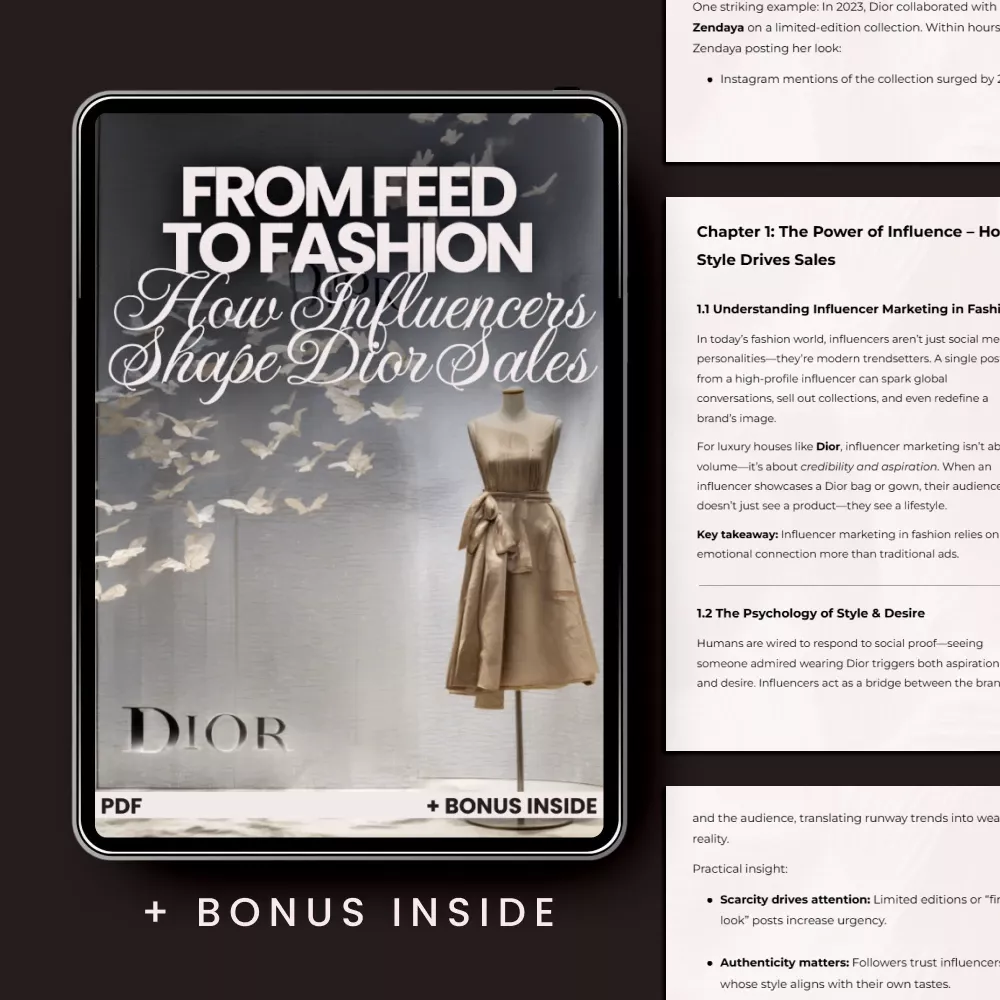


Product Description
Turn Scrolls into Sales with the Power of Influence
In today’s luxury fashion landscape, a single Instagram post can spark global demand. From Feed to Fashion: How Influencers Shape Dior Sales is your insider guide to understanding exactly how influencer style affects dior sales and why digital tastemakers have become essential to luxury brand growth. This professionally crafted digital guide breaks down the psychology, strategy, and measurable impact behind influencer-driven success—using Dior as the ultimate case study.
If you’re curious about how curated outfits, viral moments, and carefully chosen partnerships translate into real revenue, this guide gives you the clarity and actionable insight you need.
What’s Inside This Digital Guide
- Chapter 1: The Power of Influence – How Style Drives Sales Deep insights into influencer marketing in fashion, the psychology of style and desire, and Dior’s most impactful viral moments.
- Chapter 2: Influencer-Brand Dynamics How Dior selects the right influencers, the difference between collaborations and organic mentions, and how to measure engagement and ROI effectively.
- Chapter 3: Common Mistakes and Missed Opportunities Why authenticity beats follower counts, how misaligned messaging hurts luxury brands, and the role of AI-powered predictive analysis.
- Chapter 4: Future Trends & Next Steps AI-enhanced trend forecasting, micro vs. macro influencer strategies, and practical steps Dior can take to stay ahead in a digital-first world.
Who This Is For
This guide is perfect for:
- Fashion marketing students and researchers
- Luxury brand strategists and digital marketers
- Influencers and content creators in the fashion niche
- Ecommerce entrepreneurs selling high-end or aspirational products
- Anyone wanting a clear understanding of how influencer style affects dior sales
Why This Guide Is Different
Unlike generic influencer marketing eBooks, this guide focuses specifically on a globally recognized luxury powerhouse. It combines real-world case studies, psychological insights, and forward-looking AI strategies in one cohesive, easy-to-follow resource. You won’t just learn theory—you’ll understand the strategic mechanics behind luxury sales growth and how high-fashion influence turns attention into measurable results.
Practical Benefits You’ll Gain
- Understand how influencer style affects dior sales in a clear, structured way
- Learn how to evaluate influencer partnerships beyond vanity metrics
- Identify costly campaign mistakes before they happen
- Apply AI and data-driven insights to future marketing strategies
- Strengthen your luxury brand positioning in the digital marketplace
Instant Digital Download – Start Learning Today
This is a convenient digital download, giving you immediate access after purchase. No waiting, no shipping—just actionable insight you can apply right away.
If you’re ready to understand the true connection between social media influence and luxury sales performance, download From Feed to Fashion: How Influencers Shape Dior Sales today and discover how modern style leaders shape one of the world’s most iconic fashion houses.
Shipping & Delivery
SHIPPING
We are proud to offer international shipping services that currently operate in over 200 countries and islands world wide. Nothing means more to us than bringing our customers great value and service. We will continue to grow to meet the needs of all our customers, delivering a service beyond all expectation anywhere in the world.
Do you ship worldwide?
Yes. We provide free shipping to over 200 countries around the world. However, there are some locations we are unable to ship to. If you happen to be located in one of those countries we will contact you.
What about customs?
We are not responsible for any custom fees once the items have been shipped. By purchasing our products, you consent that one or more packages may be shipped to you and may get custom fees when they arrive to your country.
How long does shipping take?
Shipping time varies by location. These are our estimates:| Location | *Estimated Shipping Time |
|---|---|
| United States | 5-20 Business days |
| Canada, Europe | 5-20 Business days |
| Australia, New Zealand | 5-20 Business days |
| Central & South America | 5-25 Business days |
| Asia | 5-20 Business days |
| Africa | 5-25 Business days |
Do you provide tracking information?
Yes, you will receive an email once your order ships that contains your tracking information. If you haven’t received tracking info within 5 days, please contact us.
My tracking says “no information available at the moment”.
For some shipping companies, it takes 2-5 business days for the tracking information to update on the system. If your order was placed more than 5 business days ago and there is still no information on your tracking number, please contact us.
Will my items be sent in one package?
For logistical reasons, items in the same purchase will sometimes be sent in separate packages, even if you've specified combined shipping.
If you have any other questions, please contact us and we will do our best to help you out.
RETURNS
Order cancellation
All orders can be cancelled until they are shipped. If your order has been paid and you need to make a change or cancel an order, you must contact us within 12 hours. Once the packaging and shipping process has started, it can no longer be cancelled.
Refunds
Your satisfaction is our #1 priority. Therefore, you can request a refund or reshipment for ordered products if:
- If you did not receive the product within the guaranteed time (45 days not including 1-3 day processing) you can request a refund or a reshipment.
- If you received the wrong item you can request a refund or a reshipment.
- If you do not want the product you’ve received you may request a refund but you must return the item at your expense and the item must be unused.
We do not issue the refund if:
- Your order did not arrive due to factors within your control (i.e. providing the wrong shipping address)
- Your order did not arrive due to exceptional circumstances outside the control of estalen.com (i.e. not cleared by customs, delayed by a natural disaster).
- Other exceptional circumstances outside the control of estalen.com.
*You can submit refund requests within 15 days after the guaranteed period for delivery (45 days) has expired. You can do it by sending a message on Contact Us page
If you are approved for a refund, then your refund will be processed, and a credit will automatically be applied to your credit card or original method of payment, within 14 days.
Exchanges
If for any reason you would like to exchange your product, perhaps for a different size in clothing, you must contact us first and we will guide you through the steps.
Please do not send your purchase back to us unless we authorise you to do so.
Refunds & Returns
Order cancellation
All orders can be cancelled until they are shipped. If your order has been paid and you need to make a change or cancel an order, you must contact us within 12 hours. Once the packaging and shipping process has started, it can no longer be cancelled.
Refunds
Your satisfaction is our #1 priority. Therefore, you can request a refund or reshipment for ordered products if:
- If you did not receive the product within the guaranteed time( 45 days not including 2-5 day processing) you can request a refund or a reshipment.
- If you received the wrong item you can request a refund or a reshipment.
- If you do not want the product you’ve received you may request a refund but you must return the item at your expense and the item must be unused.
We do not issue the refund if:
- Your order did not arrive due to factors within your control (i.e. providing the wrong shipping address)
- Your order did not arrive due to exceptional circumstances outside the control of estalen.com (i.e. not cleared by customs, delayed by a natural disaster).
- Other exceptional circumstances outside the control of https://estalen.com
*You can submit refund requests within 15 days after the guaranteed period for delivery (45 days) has expired. You can do it by sending a message on Contact Us page
If you are approved for a refund, then your refund will be processed, and a credit will automatically be applied to your credit card or original method of payment, within 14 days.
Exchanges
If for any reason you would like to exchange your product, perhaps for a different size in clothing. You must contact us first and we will guide you through the steps.
Please do not send your purchase back to us unless we authorise you to do so.
Customer Reviews
See why hundreds love this product and trust us
Based on 15 reviews
Write a Review
We Think You’ll Love
Top picks just for you











The Zendaya case study in Chapter 1 — 250% surge in Instagram mentions, sold-out items within 48 hours, resale prices doubling — is the kind of concrete, sequenced data that makes abstract influencer strategy feel real and urgent.
Section 3.1's point about a mega-influencer driving millions of views but almost zero e-shop traffic finally gave me language for something I'd watched happen and couldn't explain. The audience alignment issue is obvious in retrospect, but this guide lays out exactly why follower count is a vanity metric for luxury brands. I work in digital marketing for a boutique label and the micro vs. macro framework in Chapter 4 is now informing how we brief every new campaign.
🛍️✨💫
The Book Tote example in section 2.2 is what sold me — organic micro-influencer posts while traveling quietly built one of Dior's most recognizable accessories. It reframes organic mentions from a happy accident into something worth actively cultivating 📱
Chapter 4's actionable strategy of layering macro-influencers for launch buzz and then micro-influencers for sustained conversion is the clearest version of that advice I've read anywhere. Most content stops at 'use both.' This guide explains when and why.
The pastel handbag trend example in section 3.3 — AI identifying the trend weeks early in Asia, regional influencer partnerships delivering a 35% sales lift at launch — grounds the AI claims in something tangible. That example alone changed how I think about predictive analytics as a proactive rather than reactive tool. The psychology section in 1.2 on scarcity, authenticity, and the relatability-versus-prestige balance is the kind of framing I wish I'd had three years ago when I started working with fashion clients. Before reading this, I was splitting influencer budgets almost randomly between tiers. After it, I built a tiered brief that uses macro reach for new collection launches and reserves micro-influencer spend for limited regional drops. The ROI on the first campaign we ran that way was meaningfully better. The recommendation to build a hybrid team of data analysts and creative strategists at the end of Chapter 4 is practical rather than aspirational — it's actually how the best-performing fashion teams I've seen are structured. Dense, well-sequenced, no wasted sections.
The framing in Chapter 1 — that luxury influencer marketing is about credibility and aspiration, not volume — is stated clearly and then actually followed through across all four chapters rather than abandoned after the introduction.
❤️🔥👜💎✨
Section 3.2's warning about influencers posting Dior alongside fast-fashion brands eroding exclusivity is something I've seen play out in real time and never seen articulated this directly 👏. The AI content audit suggestion that follows it is practical.
The social proof psychology section is strong — the idea that followers don't just see a product when an influencer wears Dior, they see a lifestyle, explains consumer behavior in a way that's easy to apply. The guide is well-sequenced: Chapter 1 builds the psychological foundation, Chapter 2 operationalizes it, and Chapters 3 and 4 stress-test it with mistakes and future-proofing. The only section that felt underdeveloped was the AI influencer matching discussion in 3.3 — the concept of ranking by predicted engagement and audience fit is compelling but would benefit from at least one example of a specific tool or methodology.
The three-part ROI framework in 2.3 — engagement rate, conversion rate, sentiment analysis — is simple enough to put in a brief tomorrow.
Covers the micro vs. macro debate well but the metallic footwear Gen Z example in Chapter 4 needed more detail on how Dior actually captured that early demand beyond just partnering with influencers. The strategic teasing framework and the call to measure brand sentiment and aspirational reach alongside traditional KPIs are the standout sections. Solid overall, just leaves some threads unfinished.
The conclusion's framing — influencer style as a driver of perception, desirability, and tangible revenue simultaneously — ties together all four chapters cleanly. Short guide, high concept density.
The warning in 4.3 to track aspirational reach and community growth alongside sales KPIs is the kind of nuance that separates a luxury brand strategy from a DTC one — and it's handled in two sentences without overstating it. That restraint is characteristic of the whole guide. Chapter 3's mistake examples are unusually honest for this genre, most content avoids naming specific missteps with this level of clarity. The connection between authenticity in 1.2 and the AI content audit in 3.2 — using machine intelligence to protect something inherently human — is the most interesting thread in the guide and the conclusion doesn't fully capitalize on it. Still the most practically useful thing I've read on luxury influencer strategy at this length.
Chapter 1 establishes the emotional-connection-over-advertising thesis clearly, but some of the AI claims across chapters read more like potential than demonstrated practice — the 35% sales lift from predictive analytics is cited without sourcing. The framework is genuinely useful, the evidence behind select data points is thinner than it appears.